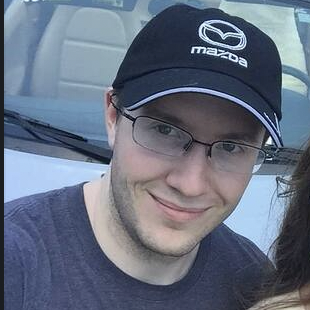
About Denny Wright
-
Technical Interests
EVs and self-driving/autonomous vehicles, videogame development, procedural generation, machine learning, and extremely spicy food.
-
University/College Attended
UMass Boston
-
Degree Received
Bachelor of Arts in English, Masters in Elementary Education
-
Hobbies/Interests
My main hobbies are weightlifting, cars, and music. My intention is to merge these with my growing knowledge of programming to hop on the EV hot rod bandwagon, and combine my love of music theory and composition to make music more accessible to everyone.
Get to know Denny Wright
What are you looking for in your next role?
Something that is intellectually challenging, professionally fulfilling, and where I can use my interpersonal, communication, and collaborative abilities to maximize the effectiveness of my team and produce something that is greater than the sum of its parts.
Why did you decide to change career and/or educational paths? What was your prior path and how did you end up down that road initially?
I got into education as a result of experiencing the impact that a truly great teacher can have on someone. My ability to control a crowd from my time in a rock band, and reflections on my own path of self-improvement from exercise and fitness made me want to guide students through that same transformative process of growth and self-discovery. Guiding 30 students at a time past the limits of their knowledge is a very fulfilling thing to do, and I was proud to be able to successfully navigate such a complex task every day. Like many people during the pandemic, I found myself looking for a new challenge. On the recommendation of several of my friends who are programmers, including a graduate of Launch Academy, I am excited to use my skills and interests in developing programs that can have a positive impact on the lives of others.
Where have you been involved in the tech community (events attended, volunteer activities, etc.)?
As of early 2022, my entire time in this community has been during the endless lockdowns of COVID, so I have not attended any events aside from the aforementioned GDC in 2015, and two years coaching a 5th grade LEGO robotics team. Once events begin again, however, I am very excited to begin attending to meet new people and learn new things.
What has been the most fulfilling aspect of your journey towards becoming a web developer? What's been your biggest challenge and how have you overcome it?
Discovering that my experience as a math teacher, musician and hobbyist mechanic have already set me up with the intellectual and conceptual capabilities to approach coding; The ability to boil complex concepts into discrete, simple steps and the fluid and contextually relative lens of music theory deeply engrain the concept of 'do a lot of simple things in a specific order', and the fact that applications are 'mechanical' systems with 'moving parts' has been comfortingly easy to wrap my head around. The greatest challenge was the level of conceptual abstraction that occurs within running code. Not being able to see with my eyes and manipulate with my hands the guts of a mechanism that either works or breaks in a fraction of a second has forced me to change the way I approach my work. Using debuggers and targeting steady, incremental progress has been a departure from my improvisational presentation that I used in my teaching.
If you had an unlimited budget and resources, what would you build?
I would create the technology to generate real, emotionally-driven musical compositions from visual, textual, and verbal input that would be good enough to pass a musical Turing test, convincing a listener that it was written and performed by a real human being. Music composition and theory exist in a very high-concept place, and for non-musicians, any kind of theory analysis can be very difficult to follow. What makes a melody float versus flutter? What makes a chord open versus hollow? Being able to see these differences, and to write music by dictation, with regular, spoken language will allow even more people to become composers and expose themselves to the really fantastic world of music theory. In the past 20 years, the advent of at-home digital audio workstations has allowed more people than ever to record their music. Places like Soundcloud and Bandcamp have allowed more people than ever to share their music. I would give this existing base of amateur musicians the ability to understand and refine their work. Millions of people are already making music at home; I would give them the tools to make their music great.