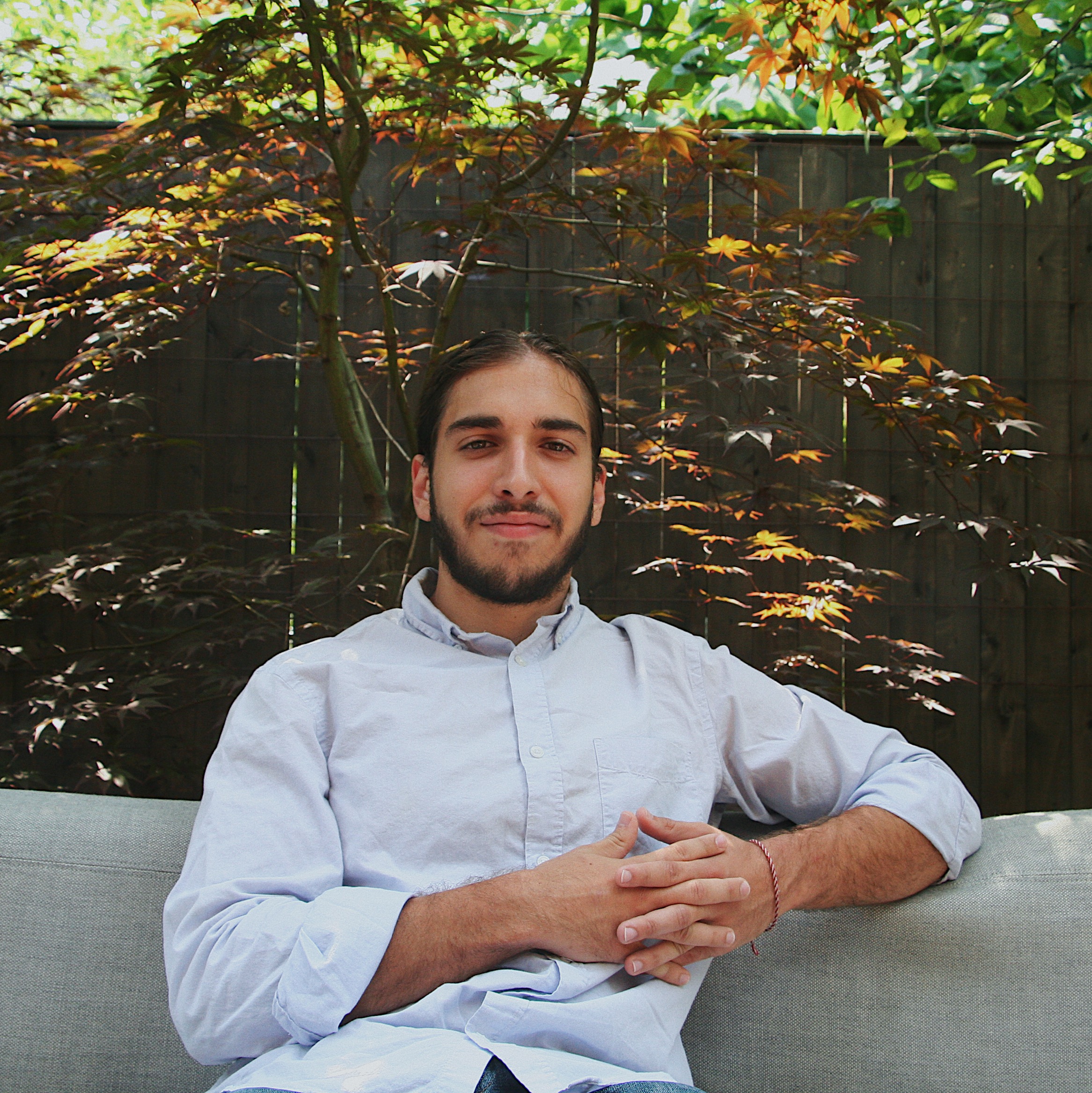
About Petar Tzonevski
-
Technical Interests
Front-end web development, Logical Puzzles, Natural Language Processing, Language Education
-
University/College Attended
University of Massachusetts Amherst
-
Degree Received
BA in Linguistics and Psychology
-
Hobbies/Interests
Football(soccer), Cinematography, Reading (novels, short stories, poems), Art (printing, painting, drawing, stenciling), Logical puzzles
-
Foreign Langauges
Bulgarian (native), Spanish (Fluent)
Get to know Petar Tzonevski
What are you looking for in your next role?
In my next role I'm looking for a place that would foster my development as a programmer, thinker, and leader. I respond to strong mentorship, and desire to make personal connections based on common interests. Ideally I'd like to work at a company that believes firmly in their product, and employs determined individuals with a sense of personal responsibility and desire for intellectual growth. I'd love to have the chance to progress into the sphere of machine learning and language processing.
Why did you decide to change career and/or educational paths? What was your prior path and how did you end up down that road initially?
I wouldn't exactly describe my process as changing my career/education path - I see it more as professional development. I am primarily a linguist, however I began coding my junior year of college when I discovered that many of my classmates in Linguistics courses were in fact Computer Scientists taking Linguistics as a general education requirement. They introduced me to the connection between linguistics and language modeling - this ability to use algorithms in tackling what is often perceived as our most dynamic quality as humans. Needless to say, I was fascinated. After taking introductory courses in JAVA and Python, I took my most challenging and rewarding class "Computational Linguistics" which happened to be UMass' only coding course in the Linguistics curriculum. I was thrilled by performing data sterilization, analyses of corpora and twitter data, Part of Speech modeling, morphological analysis, sentimental analysis, Ngram models, and CKY syntactic modeling. We used these tools to extract our desired portions from large sets of data, to model newly generated sentences, and to produce realistic sounding words/sentences. I hope to one day converge my knowledge of linguistics, web-development, and language processing to build resources for language learning.
Where have you been involved in the tech community (events attended, volunteer activities, etc.)?
I'd like to become more involved in tech groups such as Boston Data Engineering Group, Boston Software Engineers & App Developers, and Code for Boston which host hackathons and live coding sessions. Ultimately I'd like to learn how to contribute to ongoing code-bases and cooperate in projects. I'd also love to enter a hackathon either individually or with a group of like-minded collaborators.
What has been the most fulfilling aspect of your journey towards becoming a web developer? What's been your biggest challenge and how have you overcome it?
Two of the most fulfilling aspects of this journey have been, firstly, the solving of logical puzzles efficiently, and secondly, collaborating with teammates in producing a viable product. I find the characteristic transparency and cooperation within the open-source community to be particularly inspiring. I believe that all scientific, academic, and business ventures should seek to emulate the style of collaboration we find in web-development and CS. Technically, I struggled heavily with taking a step back to evaluate my requirements and formulating a clear-cut plan before I delve into the action. Initially, I found myself prematurely jumping into code, hoping that the obscurities will melt as I chip away at the implementation. What I discovered was that the foundational steps of setting up an ER diagram, Class diagram, rough design interface, and minimum viable product requirements are perhaps the most worthwhile part in the whole process. I learned to implement key features with maximal functionality before tackling my dream-features, seeing as they are often the result of minor refactoring of the already existing skeleton. I greatly value the clear-headedness that comes along with a rigid and thorough planning process, and strongly believe it fosters the most efficient coding session.
If you had an unlimited budget and resources, what would you build?
My dream is to build an all encompassing language app which provides curricula for language learners based on their level and personal interests. As opposed to the usual methodology involving textbook learning, I'd like to create a curriculum that emphasizes conversation and personality through things such as music, cinema, books, games, and puzzles. Though language apps, such as Duolingo, are great, I believe they disregard two of the most important aspects of language learning: namely, cultural integration and phonemic awareness. To speak a language requires creating an entire personality, a section of your mind wholly devoted to this language and culture. Individuals must communicate, they must listen to more skilled language users, and they must learn through their personality. This app would provide access to things such as word conjugations, word-games and puzzles, and exercises and prompts, however, the main focus would be on connecting individuals in social contexts and situations. It would provide novels, poems, and short stories along with videos, movies, songs, targeted for different levels.